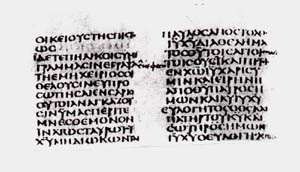
Codex Sinaiticus, with 'in Ephesus' added in the margin of Ephesians.
New Testament Alterations
Codex Sinaiticus, with 'in Ephesus' added in the margin of Ephesians.
New Testament Alterations
"It is certain that the New Testament was not written by Christ himself, nor by his apostles, but a long while after them, by some unknown persons, who, lest they should not be credited when they wrote of affairs they were little acquainted with, ...""Many things have been inserted by our ancestors in the speeches of our Lord which, though put forth under his name, agree not with his faith; especially since--as already it has been often proved--these things were written not by Christ, nor [by] his apostles, but a long while after their assumption, by I know not what sort of half Jews, not even agreeing with themselves, who made up their tale out of reports and opinions merely, and yet, fathering the whole upon the names of the apostles of the Lord or on those who were supposed to follow the apostles, they maliciously pretended that they had written their lies and conceits according to them."
St. Faustus, Fifth--Century French Bishop
No original copy of any New Testament book exists. When the originals were first made available, they surfaced and found a niche in one or another of the growing Nasarene or Christian communities around the Mediterranean. Matthew's original was probably the one called "Gospel of the Hebrews", because it was used extensively by the Nasarenes who were called Jewish Christians by those under Hellenistic or Roman culture and influence. Anyone within these ancient enclaves who desired a copy of these texts, whether for private or community use, was compelled to create a copy laboriously by hand, letter by letter, or to have another do it for them. Many of the notes and marginal comments of these older texts were written into the main body of the new manuscript, obscuring the original wording. (see the above illustration) Sometimes whole passages were left out or purposely altered to fit a changing doctrinal attitude.
Over the course of time the originals were lost, worn out, or purposely destroyed for a variety of reasons. The Nasarene, or "Jewish Christians", had a motivation to keep the original tradition inviolate and pure. All other groups, including the ones who became dominant and orthodox, had a stake in changing the original gospel and its texts to suit their own urbanized culture and different Romanized view of things. They did not appreciate the existence of the "Jewish Christians" and their more original texts and practices. In fact, they went to great lengths not only discredit them and their eye witness accounts, but even went so far as to successfully legislate their destruction in the fourth century. Many resurfacing manuscripts, such as the Nag Hammadhi library, may have been buried as a result of these persecution and book burning campaigns of the fourth century.
The selected manuscripts that survived these factional wars are not accurate copies of the original manuscripts, but rather are altered copies made from the copies of the copies of the originals. Thousands of these subsequent copies, dating from the 2nd to the 16th centuries, exist in various fragments. It is difficult to discern what the Nasarene originals once said because all of these surviving copies are too distant from the originals and differ from one another, sometimes quite significantly. Many of these differences bear eloquent testimony to a systematic alteration of the original teachings, culture and doctrines of the Nasarene Messiah. The resulting New Testament still has great value, but its doctrines, especially where they differ from known Nasarene beliefs, should be viewed with a degree of skepticism. This is especially true in the areas known to have suffered the most tampering. These include the virgin birth, when Yeshua became the Son of Amen (Son of God), the many miracles which overlap with Old Testament and Pythagorean legends, and in the matter of the resurrection.
The Greek Manuscripts
There exists about 5,487 Greek manuscripts of the New Testament. 2,811 of these are in a form of writing, minuscule, which was not used before the ninth century. 2,279 of these Greek manuscripts are lectionaries, with only 30 of them dating before the ninth century. No two of the 5,487 manuscripts are identical, except for the tiniest fragments, and not one of these 5,487 manuscripts contains the same books and order of books as found in the modern New Testament. The Codex Sinaiticus comes the closest, but it also contains the Epistle of Barnabas and the Shepherd of Hermas which are no longer considered scripture by Christians. It is note worthy that the earlier New Testament manuscripts have different wording than later copies, and where that wording differs, it usually expresses some doctrine now considered heretical by that branch of Christianity that became orthodox and mainstream.
Second Century Manuscripts (100-199 AD)
These New Testament fragments exclude Mark or any account of the later Resurrection story, and contain only the tiniest part of Acts and nothing from Revelation or 1 or 2 Peter. The numbered papyrus fragments are:
These manuscripts are more complete than the earlier ones, and some may date from the end of the previous century. Three are of particular note:
P66, from about AD 200, contains these portions of John's Gospel:
One scholar, in 'The Unauthorized Version', says of these P66 fragments:
"We have two early papyri which overlap across seventy verses of John's Gospel, and even if the plain errors of their copyists are excluded, they differ at no less than seventy small places.".
P72contains Jude and 1 and 2 Peter and sundry non canonical works, such as The Nativity of Mary, the eleventh Ode of Solomon, Melito's Homily on the Passover, the Apology of Phileas etc.
In 2 Peter 1:2, other manuscripts read "May grace and peace be multiplied to you in the knowledge of God and of our Lord Jesus." p72 deletes the "and' to read "God, our Lord Jesus". P72 also differs from the present Jude 5 to say that the savior of the people from Egypt was "the God Christ". p72 also differs from 1 Peter 5:1 to state that Peter was a witness to the "sufferings of God", and not the "sufferings of Christ", as all later manuscripts read.
P75, usually dated at 175 AD - 225 AD contains the following from John's and Luke's Gospels:
The early fourth century was a time when the Roman branch of Christianity gained almost total dominance over other rival branches, including the true remnants of original Nasarene "Christianity". They immediately began legislation and persecution against these rival philosophies and their manuscripts. In an attempt to bring these groups and manuscripts in line with the new orthodox position, Pope Damasus I, the year 382, had Jerome begin revision & unification of Latin Bibles. In 384 Jerome presented Pope Damascus I with new Latin Gospels which become the Vulgate Latin Text recognized as the standard Western Christian Bible. Once in possession of this new "orthodox" bible, the orthodox church systematically eradicated all divergent texts and those who used them, creating the scarcity of first, second and third century source material which now plagues modern Essene scholarship.
Prof. Eberhard Nestle, an expert in original evangelical texts, comments on this situation in his Einf~hrung in die Textkritik des griechischen Testaments:
"Learned men, so called Correctors were, following the church meeting at Nicea 325 AD, selected by the church authorities to scrutinize the sacred texts and rewrite them in order to correct their meaning in accordance with the views which the church had just sanctioned."
The Danish professor of religious history, Detlef Nielsen, says further:
"We have to handle many, partly contradictory texts which were written in the time period of 50 - 150 AD. In the New Testament were no less than four evangelical texts included. One tried to bring about some kind of unity which was presented as an unadulterated, true narrative of the life and teachings of Jesus, complementing each other, and which together -- though apparently unsimilar -- formed the only true evangelical text. In order to bring the various passages in harmony of each other, they were subjected to a thorough revision. As a first measure one rewrote the evangelical handwritten manuscripts, disregarding parts which did not conform, and wrote comments to make them compatible with each other. One then took to the clerical art of interpretation in order to explain the contents in such a way that
a unified evangelical text could be created."
One of the oldest evangelical texts is Mark, written by the interpreter of Peter in Rome. Papias is communicating this in his epistle to the presbyter, Johannes:
"Mark, the interpreter of Peter, recorded with great energy, if not with great accuracy, everything that he could remember had been told about Jesus. He himself had never seen the Master. He was just the interpreter of Peter, and could only retell what he had heard at various instances; not always had he got everything well explained to him and commented. One should therefore not reproach Mark ..."
Edgar Hennecke says:
"It is known that the wording of the Greek texts, which we use as a base, originate from the 5th century"
Alphred Resch says:
"Probably many of these manuscripts were kept in old monasteries in the 4th century, like Codex Cantabrigeniensis D. and Codex Syrus Sinaiticus which both marvelously survived. At the time, 382 AD during the pope Damasos, the canonical texts were adopted and in this connection all old documents were destroyed."
Many fragments and smaller manuscripts exist from these centuries. The five main western manuscripts of this period are:
Around 400 the Peshitta Bible become the standard Syrian Christian Bible. This is the Syriac (Aramaic) Vulgate, Syr(p), (OT + 22 NT, excludes: 2Pt, 2-3Jn, Jude, Rev.). This text may be of more interest to many modern Essenes due to its Aramaic language and preservation of idioms.
About this time, around 400, some think the pericope of the Adulteress, John 7:53-8:11, was probably added to Bible. From this same time period we also have the Codex Bobiensi which has "shorter", and perhaps the original, ending of Mark which does not contain the Resurrection story of Mark 16:9-20. (Jerome, circa 400, cites the "expanded" ending of Mark found after Mk16:14).
Church Father Quotes
It is often claimed that the text of the New Testament can be reconstructed from quotations of the early Church Fathers. As an example - Matthew 19.17 /Mark 10.18/Luke 18.19
Present Bibles read that "no one is good except God alone". This was changed from the older "no one is good except the Father", so as to conform with the evolving idea that Yeshua (Jesus) was also a God, just like the Father. This may seem like a small and insignificant change, but subtle differences of opinion on the nature of Christ created huge divisions within the ancient churches.
In Luke 23:53, it is written that Yeshua (Jesus) was placed in a tomb "where no-one had ever yet been laid". As a possible defense against an accusation of someone stealing the body, scribes seem to have added the words "and he rolled a great stone before the door of the tomb". The Codex Bezae was even altered to add "and having placed him there he positioned before the tomb a stone that scarcely twenty people could roll."
Luke 24:12 reads: "But Peter, rising up, ran to the tomb; and stooping down he saw the linen cloths alone, and he returned home marveling at what had happened.". This was just after Luke writes that the disciples did not believe the women, whose words seemed nonsense to them. This verse is missing from Codex Bezae and some Old Latin manuscripts. The text varies in other manuscripts. One wonders why this verse would be dropped from Codex Bezae by a scribe, especially given the reluctance of scribes to delete anything from the text? There are far more insertions than deletions, especially in the Codex Bezae, which is notorious for adding material, not subtracting it.
It is agreed among scholars that whenever Bezae and the Old Latin manuscripts agree, that reading must date back to at least the second century, if not earlier. Also, readings from Codex Bezae are found very early. Polycarp's letter to the Phillipians (AD 110) quotes the version of Acts 2:24 found in Codex Bezae.
Luke 24:12 was probably added by a scribe in the second century so as to make the Roman version of a resurrection more believable? If it was not added, then some scribes must have consciously chosen to delete it, which seems unreasonable.
The verse is very similar to Peter's rushing to the tomb in John 20:3-10. The word for the linen cloths in Luke 24:12 (othonia) is not the word that Luke has just used in Luke 23:53 (sindoni), but it is the word used in John 20:5.
This one verse, Luke 24:12, has 3 words or phrases used nowhere else in Luke or Acts. It also uses an "present tense" instead of his normal past tense used in the rest of the manuscript. Of the 93 historic presents in the Markan verses that Luke used, no less than 92 were changed by him to past tenses. This seems indicative of a pericope addition for it is missing from other important manuscripts, it has many non-Lukan features, but features which resemble John's Gospel.
Codex Bezae and many Old Latin texts do not include Luke 24:40 - "having said this, he showed them his hands and feet". Either some scribe added this verse, or some scribe dropped it. It is hard to see why any scribe would drop the verse. It is easy to see why a scribe would add the verse, basing it on John 20:20.
In Luke 24:3,Codex Bezae and most of the Old Latin texts do not have the phrase "the Lord Jesus" in "they did not find the body of the Lord Jesus." Clearly, the phrase "the Lord Jesus" was added by a scribe to make sure that the Gospels recorded that the women went to the right tomb. The phrase only occurs in this verse and in another apparent addition - Mark 16:19.
In Luke 24:6,Codex Bezae and most of the Old Latin texts do not have the phrase "He is not here, but has been raised". Apparently this phrase was another addition by a scribe to reinforce the physical resurrection theme.
Early Essene Nasarene followers of Yeshua believed that their Messiah had become the Son of Amen, or God, by growing from grace to grace within the Essene Way. The orthodox Christians maintained that Jesus was the Son of God from conception and a miracle birth. The Nasarenes, and all the original disciples, believed in a special, pure, and immaculate birth, but a birth where Joseph was the natural father and Mariam was the pure, but not virgin, mother.
Even the writings of Paul; reflect this, as in Romans 1:4 where it says that "(Jesus was) designated Son of God in power according to the spirit of holiness by his resurrection from the dead", which seems to imply that even Paul was not unsympathetic to this view.
The orthodox said, in opposition to those they called "Jewish Christians", that Joseph was not really Jesus' biological father. So some of them simply tried to eliminated those places which said that Joseph was the father of Jesus. For example, Luke 2:33 says that Jesus' "father and mother began to marvel". Many Greek manuscripts changed the text to read "Joseph and his mother began to marvel". Luke 2:48 says "Look, your father and I have been grieved". Some manuscripts were altered to read "Your relatives and I..." or "We have been grieved". In Luke 2:43 "his parents" was often changed to "Joseph and his mother".
The original Nasarene doctrine of evolving perfection leaves the door open to all of us to "follow Yeshua" into exaltation. This, of course, is not possible without a natural Essene life of strict spiritual discipline and wholehearted concentration on the world to come. Orthodox Christians, wishing an easier and more worldly path, felt comfortable altering the original doctrines so that they could comfortably pursue a normal life without any concern for perfecting themselves. With this doctrine came the companion doctrine of total vicarious atonement and total vicarious salvation through another's hard work (i.e. Christ's). Original Nasarenes believed that exaltation was a joint process involving both personal spiritual work and grace from on high.
Mark 1:1 says 'The beginning of the Gospel of Jesus Christ, Son of God". Origen, and Codex Sinaiticus, the only Great Codex to contain the entire New Testament, omit the phrase, Son of God. This is yet another example of either added or deleted phrase.
"In Luke 22:19-20 it says: "And taking bread, giving thanks, saying ,'This is my body that is given for you. Do this in my remembrance. And the cup likewise after supper, saying: 'This cup is the new covenant in my blood that is poured out for you'."
This verse is not in the 5th century Codex Bezae, and is found only as a footnote in the Revised Standard Version. It probably was not original to the Gospel of Luke. The phrase: "for you" occurs twice in this verse, and it, along with the word "remembrance" and "New Covenant", are found nowhere else in Luke-Acts. This apparent pericope is the only place where Luke seems to imply that Jesus died 'for your sins' or 'for you'.
New Testament Miracles
On page 176 of the New Jerome Biblical Commentary, written by a group of Catholic scholars, it says that 2 Kings 4:42-44 is 'obviously the inspiration for the New Testament multiplication miracles'.
In 2 Kings 4:27-37 a distraught parent of an only child comes to Elisha just as in Mark 5:22-24 (which continues in verses 35-43) a distraught parent of an only child comes to Yeshua (Jesus), pleading for help.
The best selling commentary on Matthew in the UK is by J.C.Fenton, who was Principal of Lichfield Theological College. He says about Matthew 8:24 'but he was asleep recalls Jonah 1:5, Jonah ...was fast asleep.' In both Mark 4 and Jonah the witnesses after the sea calming miracle are portrayed as afraid and awe-struck. In Mark 4 'feared with great fear (ephobethesan phobon megan)'. In Jonah (LXX) 'feared the men with great fear' (ephobethesan hoi andres phobon megan)
Yeshua (Jesus) in Luke 7 raises the son of a widow from the dead. In 1 Kings 17, Elijah raises the son of a widow from the dead. Both stories employ exactly the same words - and he gave him to his mother. The Greek is 'kai edoken auton te metri autou', copied word for word from the Septuagint version of 1 Kings 17.
Did Luke use 1 Kings 17 as a basis for his story? Yeshua (Jesus) met the widow at the gate of a city. Elijah met his widow in 1 Kings 17:10. It should come as no surprise that it was at the gate of a city. Luke 7 also copies other phrases from the Septuagint version of 1 Kings 17. Luke copies 'kai egeneto' (and it came to pass). Luke writes 'tay pulay tays poleos kai idoo' (to the gate of a city and behold), which is almost identical to the Old Testament Greek of 'tou pulona tays poleos kai idoo'.
Curiously, John 4 uses the elements of 1 Kings 17 that Luke does not. In John 4, Yeshua (Jesus), while in a foreign land, meets a woman who no longer has a husband, just as Elijah does. Both Elijah and Yeshua (Jesus) are thirsty and have to ask the woman for a drink . In both stories, though, it is the woman and not the prophet who is in true need. Both Elijah and Yeshua (Jesus) promise her a never ending source. Both 1 Kings 17:24 and John 4:19 make the women certify the miracle worker as a true prophet.
It appears that the early non-Nasarene Christians drew upon the one source that they held to be infallible - the Old Testament. They felt quite justified in taking stories from the Old Testament and applying them to Yeshua. They believed that the Torah was full of hidden 'prophecies' that were fulfilled by Yeshua and they apparently felt quite comfortable assigning these same miracles to their Yeshua biography. They seem to have had no qualms in departing from historical facts as long as they enhanced the miraculous nature of Yeshua in pursuit of their own purposes.
Conclusion
It is apparent that many of the doctrines, traditions, and writings of the earlier Nasarene disciples of Yeshua were either destroyed or altered over time by those adhering to Roman, rather than Essene, culture. "The Way" of the early nature loving Nasarenes eventually began to be labeled heretical, and all who held to these original beliefs were persecuted and their scriptures banned and burned. This persecution, so systematic and state supported, resulted in the rewriting of history and scripture and in the recasting and reinterpretation of the meaning and mission of the Essene Yeshua.
Maria was labeled a repentant and unimportant whore and Yeshua, like other pagan gods, was put so high on a pedestal that no one would think to actually follow in His footsteps or attempt to actually live the fulness of His teachings.
The original and Essene view of Yeshua, in contrast to the orthodox stance, does not diminish His value, importance, or unity with Amen (Deity). Rather, it makes them more accessible and makes it more possible to follow in His footsteps for the following reasons.
A realization that Yeshua fully became Christ only later on in His life, rather than at birth, means that we too can become "anointed" through following the path that He has so beautifully outlined for us. A sonship, or daughtership, with Deity that is innately inherent but ultimately realized only later on in life thru a series of purification and initiations makes it more feasible for all of us to obtain enlightenment and perfection, whether in this life or another. This realization lends itself toward greater dedication and personal responsibility and saves one from thinking that the fate of their birth determines their destiny.
A perception that many of the miracle stories of the New Testament are more allegorical than actual, allows us to appreciate Yeshua for the truth He taught rather than the magical tricks He allegedly performed.
An understanding that Yeshu's "resurrection" from the grave was a spiritual triumph over death, and not a physical one, does not diminish the import of His life, sacrifice, or compassionate grace for us. It allows us to focus on the truth and triumph of the spiritual world, rather than the material, so that like our Buddhist brethren and sistren, we may cultivate a true understanding of enlightenment, liberation from the material world and eventual absorption into eternal spiritual bliss.
As for the New Testament, it is clear that it is not a perfect book or a completely accurate historical record, as some would have us believe. It is, nevertheless, a wonderful testament to Yeshua the Messiah, despite its many flaws, deletions and additions. It is important to note that the original disciples and their descendants took little notice of these gospels, according to Jerome, or the Pauline epistles; preferring instead to base their foundation on the Gospel of the Hebrews which unfortunately is no longer available to us as a historical record. Modern Essenes have, however, several important and useful texts which are close to, if not identical with, early Nasarene sacred scrolls and scriptures. These include some of the Dead Sea Scroll manuscripts such as the Damascus Document and Manual of Discipline, Nag Hammadhi codexs such as the Gospel of Thomas and Philip, an Essene New Testament brought forth by Ouseley, Essene Gospels of Peace brought forth by Szekely, and other helpful historical manuscripts such as the Clementine Homilies.
The Nazarenes of Mount Carmel
Copyright
© 1999-2016. The Nazarenes of Mount Carmel.
The Essene Numerology
Chart | Ministerial Training
Course